

The waterfall is formed when rivers or streams flow over vertical hills or cliffs in the landscape. A continuous erosion process creates waterfalls. Erosion plays an essential role in shaping landscapes and forming waterfalls.
How Are Waterfalls Formed?
The formation of a waterfall is a process that involves several geological and physical factors. The primary factor is erosion. Waterfalls often form in young rivers, where the water’s speed and volume are high. The interaction between hard and soft rocks also plays a crucial role. The softer rock erodes more quickly.
The Stages of a Waterfall Formation

Here are the stages involved in waterfall formation:
01. Erosion and Differential Rock Resistance
Rivers flow on rock bands of varying resistance. Some stones are hard, and others are soft. Less stable rock breaks down faster due to differential erosion. Erosion occurs through three main processes:
Hydraulic action: The force of water penetrates small cracks and breaks the rock.
Abrasion: The river bed and banks are eroded by the load (sediment) hitting them.
Corrosion: River water dissolves minerals from rocks.
02. Formation of a Waterfall
The river gradually erodes the soft rock, creating a ledge in the stream or river. Over time, this step will become larger, and the rock will become harder. The soft rock does not support the hard rock on top. Eventually, the mantle collapses, resulting in a waterfall.
03. Plunge Pool Creation
As the ledge falls, some of the stones roll along the river, forming a deep plunge pool below the falls. When the flow is high, the plunge pool becomes deeper because the hydraulic power is stronger.
04. Gorge Formation
The waterfall continually moves upstream, repeating the process of erosion. As a result, a steep-sided gorge is cut back into the hillside.
The Role of Erosion in Waterfall Formation
The formation of waterfalls happens through the erosion process. The erosion process keeps rocks and soil away from the force of water. Erosion plays an essential role in shaping the landscape and forming the waterfalls.
As water flows downstream, it encounters different types of rocks and sediments. Over time, the force of the water weakens the softer rock while the harder rock remains intact. As the water continues to flow over the cliff’s edge, it creates a vertical drop, giving birth to waterfalls.
Waterfalls often form in young rivers with a fast flow and large volume. The interaction between hard and soft rock plays an important role. Soft rock erodes more quickly.
Additionally, the obstructions of rocks in the waterway can increase erosion and contribute to creating a unique waterfall shape.
Example Types of Waterfalls
| Type | Characteristics | Examples |
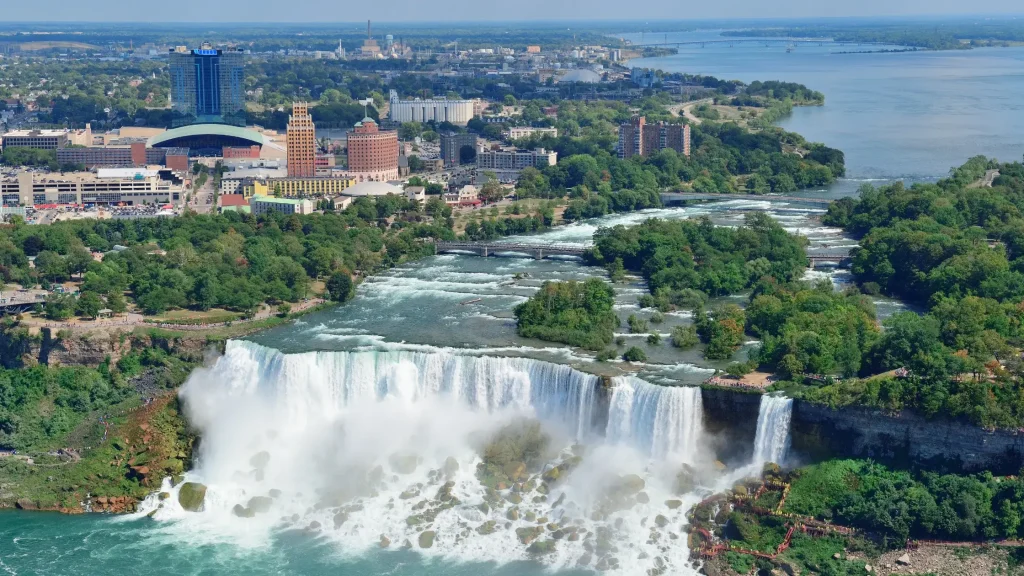
| Block | Wide stream | Niagara Falls (USA/Canada) |
| Cascade | Series of steps | Monkey Falls (India) |
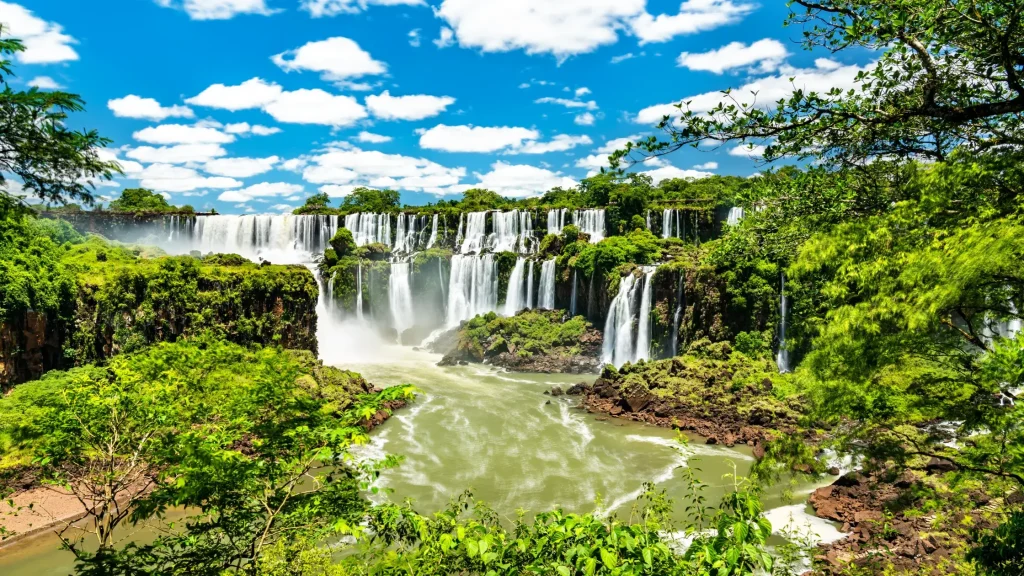
| Cataract | Powerful, dangerous | Iguazu Falls (Argentina/Brazil) |
| Chute | Narrow stream | Three Chute Falls (USA) |
| Fan | Spreads horizontally | Virgin Falls (USA) |
01. Niagara Falls
The Famous Niagara Falls on the border of New York and Ontario exemplifies the power of erosion over time. Formed from waters from the Great Lakes plunging over the Niagara Escarpment, the Crestline spans over 1200 meters across. The sheer volume and height make it one of the most breathtaking sights on the planet.
02. Monkey Falls
The famous Monkey Falls in Tamil Nadu, India, is an example of hydraulic action and abrasion waterfall creation.
03. Iguazu Falls
The Iguazu Falls, the largest waterfall system, is located between the border of Misiones (Argentina) and the state of Parana (Brazil). According to Facts.net, About 150 million years ago, a volcanic eruption completely changed the landscape of this area. This eruption caused cracks and fissures in the Earth’s crust. Over time, these natural cracks led to the creation of Iguazu Falls.
04. Three Chute Falls
The Three Chute Falls, located in California, USA, waterfall’s creation involves the interplay of erosion and the unique rock composition.
05. Virgin Falls
Virgin Falls, located in the Southeastern United States, is formed by an underground stream that emerges from a cave. This stream flows unseen beneath the surface until it reaches the edge of a cliff.
The Impact of Climate on Waterfall Creation
The amount of rainfall water distribution in an area affects a waterfall’s formation and existence. Climate plays a significant role in the waterfall and its creation.
The regions with high rainfall have more water flow to contribute to rivers and streams. The increase in water volume can create larger and more powerful waterfalls. On the other hand, areas with low rainfall may have smaller or temporarily dry ones.
Temperature is also involved in waterfall formation, the colder regions contributing with snow and ice to the waterfalls, which are called frozen waterfalls.
Climate is the reason for water flowing over time. The climate is essential in flowing the water or temporarily drying it. As humans, it’s our responsibility to reduce climate heat to protect these natural wonders.
The Waterfalls Impact on the Environment
The waterfalls have a significant impact on the environment in several ways. Below, I have addressed the top five water-producing waterfalls for our environment according to the list of waterfall flow rates and how much water they can discharge per second.
Inga Falls: Discharges an enormous 25,768 cubic meters of water per second into the Congo River.
Livingstone Falls: Discharges 25,060 cubic meters of water per second into the Congo River.
Boyoma Falls: Discharges 16,990 cubic meters of water per second into the Lualaba River.
Khone Phapheng Falls: Discharges an enormous 11,610 cubic meters of water per second into the Mekong River.
Pará Falls: Discharges 3,540 cubic meters of water per second into the Caura River.
Human Interaction and Waterfalls
With our dams and development, humans can sometimes impact these creations. Dams change a river’s natural flow, affecting the waterfall’s flow. Also, that can change the rhythm and volume.
Currently, many places are committed to preserving these waterfalls. Conservation efforts help ensure future generations can witness the waterfalls and their flow.
How long does it take for a waterfall to form?
Forming a waterfall is a vast process that can take thousands or even millions of years, depending on various factors. The time it takes to create a waterfall depends on the area’s geology and the water flow’s strength. It can be faster in some regions due to climate factors.
The Evolution of Waterfalls Over Time
Waterfalls are not static formations. They undergo constant changes and transformations over time. The evolution of waterfalls is a significant process of erosion. As water flows over the edge of waterfalls, It erodes the rocks and shapes the size of the waterfall. Over thousands or millions of years, this erosion can create a new ledge or cliffs from the water drop. This process contributes to the creation of gorges and canyons.
Another factor influencing the formation of waterfalls is the movement of the Earth’s crust. Tectonic activities, such as land uplift or subsidence, can affect the flow of rivers and streams and lead to changes in waterfall systems. Earthquakes and volcanic activity can affect the formation and appearance of waterfalls in certain areas.
Case Studies and Research
Recent research has shown that waterfalls can also form spontaneously, without the need for an external influence. Joel Scheingross, an assistant professor in geological sciences at the University of Nevada, Reno, studied this spontaneous formation of waterfalls.