If you want to get better at art, understanding the elements and principles of art is crucial. These fundamentals act as the language of art, enabling artists to convey messages and emotions. They guide the artists through creation and make decisions to achieve the desired impact.
Try the elements and principles below to become a better artist and attract more art viewers.
What are the seven elements of art?
Principles of Art
The importance of art elements
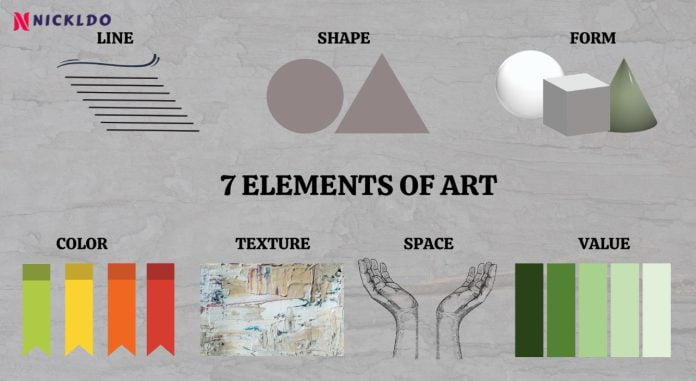
The elements of art are the building blocks of all art pieces. They include line, shape, form, colour, space, texture, and value. Each element plays a vital role in the overall composition of an artwork.
For example, lines can direct the viewer’s eye around the image. Colours can set the mood or express emotions.
01. Line
In art, a line is more than a mark. It’s a fundamental element that shapes our understanding and appreciation of a piece. Lines define boundaries, create forms, and express emotions. They’re crucial in conveying the artist’s message, guiding the viewer’s eye into art.
There are various lines, each carrying its weight and impact.
Types of Line
Straight lines: They’re direct and often used to outline shapes and define edges.
Curved lines: Create a sense of grace and dynamism, essential for depicting movement and natural forms.
Vertical lines: Convey strength and stability, often giving artworks a sense of height and grandeur. Horizontal lines are the calm counterparts, promoting tranquility and breadth. They can create a restful atmosphere.
Diagonal lines: They break the calm, introducing tension and excitement. Diagonals suggest movement and instability, often leading the viewer’s eye on a dynamic journey across the canvas.

The emotional impacts of these lines are profound. Lines do more than fill space; they direct our gaze and influence our feelings towards a piece. An artist’s use of lines can guide us through their work, stories and messages. The line is capable of transforming a flat surface into vibrant scenes.
Understanding the types of lines and their emotional impacts is key to appreciating art at a deeper level. It allows us to see the artist’s intent and emotions beyond the surface.
02. Shape
Shape plays an important role in art, and It comes in two main shape types as below:
Geometric Shapes: These are the ones we are more familiar with, such as circles, squares, and triangles. They have a clear, defined edge
Organic shapes: These are irregular shapes we find in nature, like outlines of leaves. Strict rules don’t bind these shapes, and they are primarily unpredictable in appearance.

Using shapes requires an understanding of both their visual impact and their emotional resonance. Their clean lines and angles make geometric shapes bold and assertive. Organic shapes, with their unpredictable curves, can convey warmth and approachability
Understanding these elements, artists can create art that draws viewers who can explore the deeper meaning and emotions included in the art.
03. Form
Form in art is a step beyond shape. It moves from the flat to a complex of three dimensions. The form is about depth, volume, and perception. It’s how a circle becomes a sphere, a square turns into a cube, and flat drawings gain the illusion of space. This transformation is making the depicted scenes and objects come alive.
Light and shadow play crucial roles in this transformation. They’re the artists’ tools for tricking our eyes into seeing depth on a flat surface. Light highlights contours, while shadows fill recesses, creating a sense of solidity and dimension. This interplay is delicate. It requires skill to master, but when done right, it breathes life into forms, making them feel real.

Forms find expression across all art mediums, each offering unique challenges and opportunities. In sculpture, form is direct and literal. Sculptors mold their materials, be it clay, stone, or metal, into three-dimensional forms. These forms occupy real space, allowing viewers to interact with them physically, moving around to see different angles and perspectives.
Digital art, by contrast, starts in a virtual space. Artists use software to simulate light and shadow, building forms through pixels. The challenge is to create a sense of depth within the confines of a screen.
Each medium uses different approaches, but the end goal is the same: to give viewers a sense they are viewing beyond the surfaces.
Shape Vs Form
As mentioned above, we’re moving from the flat world into one with depth when discussing shape versus form. The shape is two-dimensional, having only height and width. Form adds another layer – depth. Think of a drawing of a cube. The artist uses perspective to transform square shapes into a form that pops off the page.
04. Colour
Colour is a vibrant element of art, painting our world in endless hues. At its core is the colour wheel, a fundamental tool that maps the spectrum of colour. It starts with the primary colours: red, blue, and yellow. These are the seeds from which all other colours grow. Mixing them gives us secondary colours: green, orange, and purple. By blending primary and secondary colours, we make tertiary colours, creating a full circle of colour possibilities.
Warm colours, like red, orange, and yellow, create feelings of warmth and energy. They grab our attention—cool colours like blue and green offer a sense of calm.

Colour theory dives deeper, exploring how colours interact and affect each other.
Complementary colours: opposite each other on the colour wheel, offer striking contrast and vibrancy when placed side by side.
Analogous colours sit beside each other on the wheel, creating harmony and unity, soothing the eye.
Monochromatic colours: variations of a single colour offer simplicity and cohesion.
The psychological impact of colours is profound. They can sway thinking, change actions, and cause reactions. Red can signal danger or passion, blue can soothe or depress, yellow can energize or irritate.
Colour is another element which showcases the deep emotional level of art. Mastering the colour will enable the artist to convey messages without words. Colours also attract the viewer’s heart and mind.
05.Texture
Texture in art plays a dual role. Something you can feel with your touch, or visual, where the appearance alone suggests how something might feel. This duality enriches artworks, adding layers of complexity and emotion.
In painting, artists can create physical texture. They might layer paint thickly, a technique known as impasto, to make the surface feel rough or bumpy. Other times, they might add materials like sand or fabric to the paint, introducing a literal texture that invites the viewer to imagine the sensation of touching it.

Texture, whether tactile or visual, significantly impacts how we experience art. It can make a scene feel more natural and immersive, pulling us into the artwork. Textured surfaces catch the light, creating shadows and highlights that add depth and interest. In a landscape, rough textures might make rocks and trees feel rugged and wild, while smooth textures can make a body of water look calm and reflective.
Techniques for creating texture for each medium are different. In physical mediums like painting and sculpture, artists manipulate materials directly. In digital art, the challenge is to make the illusion of texture within the confines of a screen.
06.Value
Value in art is all about light and dark. The scale ranges from pure white through shades of grey to deep black. This range is crucial for artists. It helps them create depth, mood, and focus in their work. Understanding value is key to mastering the visual impact of art.

Values are more than just shades; they tell stories. Light values suggest openness and clarity, making spaces feel airy and bright. Dark values add mystery and depth, often creating drama or somberness. This interplay shapes the emotional tone of a piece.
Creating a mood relies heavily on value. A painting with soft, light values might evoke a serene, peaceful feeling. In contrast, a scene dominated by dark values could convey tension or fear. Artists pay close attention to value distribution in their work.
Value also defines form. By shading an object from light to dark, an artist can make it appear three-dimensional, even on a flat surface. This illusion of form is fundamental in drawing and painting, where depth must be suggested through skillfully using values.
Highlighting the focal point is another critical use of value. Artists often use contrasting values to draw the viewer’s eye to the key part of a composition. A bright light in a dark room, a dark figure against a light background—these contrasts make the focal point stand out, guiding the viewer’s attention where the artist intends.
07. Space
Space in art refers to the distance or area between, around, above, below, or within elements. It’s a core component that artists manipulate to create the illusion of depth on a flat surface. Space can be positive (filled with something, like an object or subject) or negative (empty areas around and between subjects).

The role of space in art cannot be understated. It helps to define the boundaries of objects and determines the scale and proportion of the composition. Space gives the viewer’s eye a path to follow, guiding them through the artwork.
Space can be used to focus attention on the main subject of the piece, enhancing its significance
Understanding and using space effectively allows artists to create more engaging and dynamic pieces.
By mastering these seven elements, artists can create complex, attractive art that draws viewers.
The importance of art principles
Creating perfect art is a complex and huge process. Artists rely on principles of art to guide their work. These principles shape the structure of art, infusing it with depth and meaning. They’re not just rules. They’re tools that, when used wisely, can turn a simple idea into a masterpiece. Here’s how:
Balance
In art, balance ensures that no part of the work overwhelms another. This can be symmetrical, where both halves mirror each other, or asymmetrical, where different elements counterbalance each other. Balance creates a feeling of stability, making the viewer feel at ease.

Contrast
Contrast is key to drawing attention. This principle highlights important details, guiding the viewer’s focus to where the artist wants it. This principle adds drama and interest, keeping the viewer engaged.

Emphasis
Emphasis is like saying, “Look here! This is important.” Artists can use brighter colours, larger sizes, or more detailed textures to make the focal point stand out. Emphasis ensures the artwork’s message gets noticed in the background noise.
Movement
Movement brings life to art. It directs the viewer’s eye across the canvas, creating a path that tells a story. This principle adds dynamism and flow, making the artwork feel alive.
Pattern
The pattern repeats elements to create interest and consistency. Patterns can be simple or complex, but they always add a sense of predictability to the art. This principle engages the viewer’s brain, creating a rhythm to follow.
Rhythm
Rhythm is a familiar word in music. In art, it’s about creating a visual tempo. Rhythm provides a pace to the artwork through repetition or alternation of elements. It makes the viewing experience more dynamic as the eye dances from one part of the piece to another.
Unity
Unity ties everything together. It’s the sense that all artwork parts belong to a cohesive whole. Unity can be achieved through colour schemes, similar textures, or a consistent style. It gives the artwork a sense of completeness.
Variety
Variety adds spice to art. It’s the use of different elements to create interest and break monotony. Variety challenges the viewer, offering multiple points of engagement within the artwork. It ensures that the piece is vibrant and captivating.
Applying these principles, artists showcase their emotions and feelings while engaging viewers. Understanding these principles enhances the artist’s technical skill behind the art. These are not just rules. They help to draw a balanced and engaging art for viewers. Also, it provides the deeper meaning of art.
A study at the Malaysia Art School in Johor by Zolkipli Abdullah and Syahrul Azlina Sikandar shows the importance of these principles in theater production. Their work explains that following these guidelines boosts students’ creativity and ability to think out of the box. It also describes the challenges and opportunities in teaching these principles.
Even if you are a beginner in art or a professional, understanding these concepts is essential. It allows create of more depth of art.